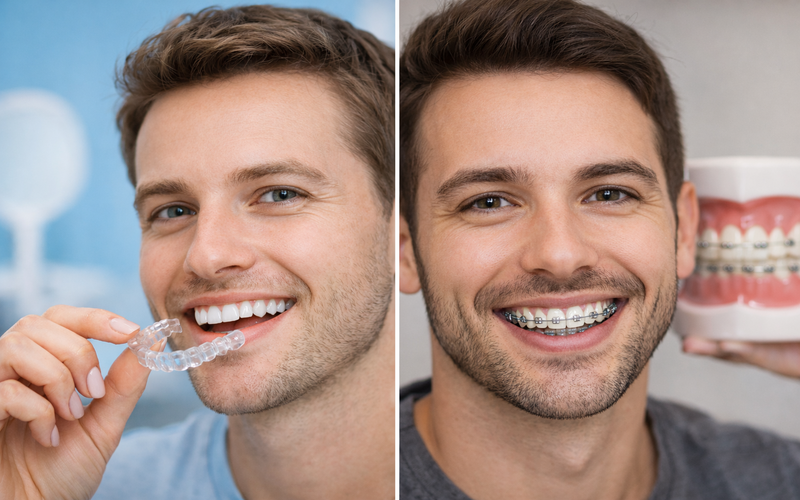
At Specialist Dental Services, we provide consultant-led orthodontic care for both straightforward and complex cases. One of the most common questions we’re asked is:
“Should I choose aligners or traditional braces?”
The honest answer is this: both are excellent tools. The right choice depends on your teeth, your bite, your goals, and sometimes on surgical or multidisciplinary considerations. Our role is not to sell a system, but to select the most biologically sound and predictable approach for your individual case.
Modern Orthodontics: More Choice, Better Outcomes
Orthodontic treatment has evolved dramatically. Today, patients benefit from:
As consultant orthodontists, we routinely manage complex malocclusions, facial asymmetry, impacted teeth, bite correction, and multidisciplinary cases, working closely with oral surgeons, restorative dentists, periodontists, and general dentists.
Clear Aligners: Discreet, Digital, Powerful
Aligners are removable, transparent trays that move teeth in carefully planned stages. When designed and supervised properly, they can deliver highly accurate results — even in complex cases.
At Specialist Dental Services, we use multiple aligner systems, allowing us to choose the most suitable platform for each case:
This flexibility matters. Different systems offer different biomechanics, attachment strategies, and staging options, which can be critical in advanced treatment.
How Aligners Work: The Treatment Flow
Aligner treatment follows a structured, consultant-led pathway:
When Aligners Are Particularly Useful
Aligner treatment starts from £6000.
Traditional Braces: Precision, Control, Reliability
Fixed braces remain the gold standard for many orthodontic problems, particularly where absolute control of tooth movement is required.
At Specialist Dental Services, we offer both metal and ceramic braces, tailored to your clinical needs and aesthetic preferences.
Types of Braces We Offer
Metal Braces
Ceramic Braces
How Traditional Braces Work: The Treatment Flow
Braces Pricing
Mini-Screws (TADs): Expanding What’s Possible
Mini-screws, also known as Temporary Anchorage Devices (TADs), allow us to move teeth in ways that were previously difficult or unpredictable.
They can be used with both aligners and braces to:
Their use reflects a specialist, consultant-level approach to orthodontic biomechanics.
Orthognathic (Jaw) Surgery: When Teeth Alone Aren’t Enough
In some cases, the underlying issue is the position of the jaws rather than the teeth. For these patients, orthodontic treatment is combined with orthognathic surgery to achieve optimal facial balance, function, and long-term stability.
We regularly manage:
Both aligners and braces may be used depending on the surgical plan and biomechanics required.
So… Aligners or Braces?
There is no universal “better” option — only the right option for you.
At Specialist Dental Services, every treatment plan is consultant-designed, evidence-based, and tailored to your needs — not limited by a single system or approach.
Book a Specialist Orthodontic Consultation
If you’re considering orthodontic treatment and want a clear, honest assessment of your options, we invite you to book a consultation at Specialist Dental Services.
We’ll help you understand:
Because great orthodontics isn’t about choosing aligners or braces — it’s about choosing the right treatment, delivered at the right level.

Shakeel is one of the leading dentists in london, Consultant and Honorary Clinical Professor at The Royal London Dental Hospital, Barts Health NHS Trust and Queen Mary University of London. Shakeel specialises in treating patients requiring complex and advanced restorative treatment including surgical placement and restoration with dental implants.
Posted On : December 22, 2025
MORE DETAILS
ADDRESS: 94 HARLEY STREET, LONDON, W1G 7HX
TEL: 020 7580 4200 | SMILE@SPECIALISTDENTALSERVICES.COM
Fields with (*) are required.
Please contact us via this website or email without disclosing confidential information.


 LIKE
LIKE
 COMMENT
 SHARE
SHARE